KLiving Blog
How to Avoid Credit Card Traps
The minimum payment is the trap. Here's how it's calculated, why it keeps you in debt, and what a subprime card really costs.
On this page
Credit cards offer two things: the convenience of not carrying cash, and access to funds you don't currently have. You borrow from the card company until your payment date, and they'll typically give you that money interest-free for an average of 21 days — as long as you pay the total balance by the due date.
But if you can't pay off the full balance, you'll pay far more than you expect.
Don't be fooled by the "minimum payment"
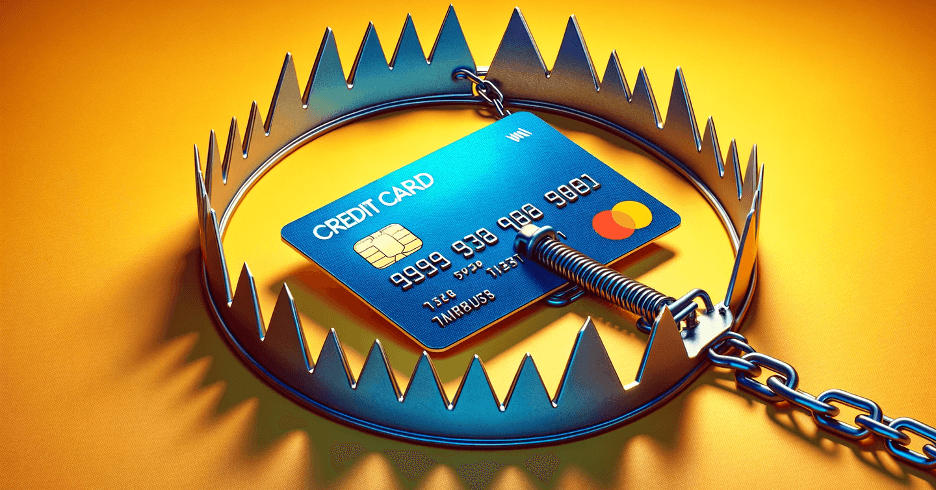
If you have a high interest rate — say 29.99% — and the card offers a minimum payment of 2% of the balance, you may never pay the card off in your lifetime. The interest charged each month can be higher than the minimum payment itself. That's the trap: a minimum payment designed so you never pay off the balance.
How minimum payments are calculated
A minimum payment is usually based on your monthly balance, including any fees and interest. Two methods are common:
Flat percentage. You pay a percentage of your total statement balance, including interest and fees — usually 1% to 3%. If your minimum is 2% and your balance is $5,000, you owe $100.
Percentage plus interest and fees. You pay a smaller percentage of your balance — say 1% — plus the interest and fees accrued that period. On a $5,000 balance with $80 in interest and $40 in fees, a 1%-plus-interest-and-fees minimum would be $170.
A few things can change the math. A small balance may result in a fixed minimum, such as $25 or $35 (or the full balance if you owe less than that). The issuer may also add any overdue amount to your minimum.
Quick math
If you pay $30 a month (3% of the balance) to pay off a $1,000 purchase at a 29.99% interest rate:
- Total you'll pay: $2,165.76
- Total interest paid: $1,165.76
- Time to pay off: 6 years
Cards offered to subprime consumers
The Consumer Financial Protection Bureau groups credit scores into five tiers:
- Deep subprime — credit scores below 580
- Subprime — credit scores of 580–619
- Near-prime — credit scores of 620–659
- Prime — credit scores of 660–719
- Super-prime — credit scores of 720 or above
Nearly every card aimed at subprime consumers advertises "a way to build credit" — but at what cost? Typical terms can charge roughly 50% to use a $500-limit card. Here's how that adds up:
- $500 credit limit
- $99 annual fee
- 29.99% interest rate
If you used the full $500 in the first few days, couldn't pay it off, and only made the minimum payment to cover interest, you'd pay roughly:
- $150 in interest charges
- $99 in annual membership fee
- $249 total to use $500 — plus any late fees, ATM fees, and the rest
When a card costs you half its own limit in a single year, it isn't helping you build credit faster than it's draining your wallet. Read the rate and the fees before you apply.
Keep reading
Is the Free Phone Really Free?
Free-phone deals come with five conditions. Here's what each one really costs — and why the answer is usually "no."
High Interest, Low Balance: Subprime Credit Cards Compared
Cards built for rebuilding credit come with high fees and low limits. We compare Credit One and Milestone against secured cards.
How Credit Card Interest Is Calculated
Interest isn't a black box — it's a simple daily formula. Once you see it, you'll know exactly why a balance costs what it does.